When the Lights Go Down
An upcoming archival Yes recording offers hope that perhaps we're close to the edge of some other treasures emerging....plus some thoughts on being a collector + some recent interesting developments.
Anyone who knows me for even a short period of time will come to learn that I’m a big fan of live albums and over the years, collecting live bootlegs from my favorite artists.
If I’m going to put a beginning stamp on it, we’re going back at least nearly 40 years to Christmas of 1986 when my parents gave me one of the biggest musical presents I’d hoped to find under the tree that year, Bruce Springsteen’s mammoth Live 1975-85 box set.
As a growing Springsteen fan, it opened a new door and made me realize that there was a lot more to hear from Bruce and somehow, even in that moment, I knew we were only getting a partial snapshot with the contents of the box.
By the ‘90s, I was collecting additional Springsteen bootlegs, both in certain record stores and via mail order and eventually, through tape and CD trading, but that came later.
Some of the first bootleg trading I did happened with a friend who I’m still in contact with more than 30 years later as he started to send me some choice recordings on cassette of Del Amitri, another big favorite. I connected separately with someone else who was a big Michael McDermott fan and had gotten close with Michael, who had given him permission to tape shows from the soundboard. My love for collecting live music blew up in the ‘90s and that’s just a very small snapshot and a couple of examples.
In the music industry, one thing I hear people say quite a lot is that anyone who is collecting bootlegs (however it happens these days and there are many different ways, hello, YouTube and hello, files) already owns all of the albums by the band or artist they’re pursuing.
There’s an asterisk on that thought with streaming, but I think the point is still valid. They’ve bought the live albums and they still want more. This doesn’t hurt your band or artist, because as you continue to release things, they’ll continue to buy them.
In this age where artists are seemingly putting out everything, after decades of waiting for some of them to put out anything from their archives, it’s become clear who has a lot of stuff in master tape quality vs. those who clearly don’t. Some of the artists, like Pink Floyd, it’s pretty well-known that they have large gaps in their touring history where they didn’t professionally record anything. To that end, Sony/Legacy recently released (in the past couple of years) a legendary 1975 Floyd recording from Los Angeles — from an audience tape source recorded by late taper Mike Millard, whose recordings are building their own legend with fans who are hearing them.
While taking an audience recording like the Pink Floyd concert and releasing it officially is less common, it’s happened a decent amount in the past (a rabbit hole we won’t go down with today’s entry) and has allowed us as music fans to hear certain tours at a mainstream level with officially released product that fans who are not serious collectors (and as a result, would likely remain unaware of the existence) to own recordings from key tours that were not previously available to them. As you know, for shows or tours that you saw personally, or things from a period of a band that you particularly hold dear, it’s an opportunity that means a lot.
Yes and Chicago are two bands that I always wanted more from (again, just a couple of artists from a much longer list). While I had no shortage of bootlegs from each of them, I wished we could get more from their archives. Better copies of certain shows or even just official ones that already sound great.
The initial live box sets from each suggested that perhaps those archives were a bit thin. In the case of Chicago, their Decades Live box set seemed to reveal that their own personal holdings were a bit patchy, particularly as you get into the ‘80s. Yes put out The Word is Live, painting a similar picture.
With each box set, fans were frustrated, knowing the wealth of material that they had personally that sounded better. In the years since Chicago released that box set, they’ve opened the door a bit more, putting out a box set of all of the shows recorded for their Carnegie Hall live album that’s really fantastic. They have so much improvisation in their live performances from that era that it’s a real treat to hear each concert, because you feel like you’re taking a different journey every night they step on stage and the song selection varies as well.
They put out another show, recorded later the same year after the Carnegie Hall run that seems like it would be redundant, but again, because of how Chicago was developing and evolving at that time, it’s a magnificent listen.
The Yes releases have been a different story. They do have a lot of official live albums already that they’ve released over the years (something which was not the case for many years with Chicago, who had only put out an initial Carnegie Hall live release in the ‘70s that didn’t sound great, and a Japan live release, import only, from that same relative era that sounded much better).
Progeny: Seven Shows From Seventy-Two, released in 2015, presents seven full shows from the Close to the Edge tour, a set that was assembled after a number of multi-track recordings of concerts from that time period were discovered. There was still a lot of cleanup work required and I wish I could find my copy of the book that goes with that box set, because it’s a pretty fascinating story of how they prepared the recordings for release. (Among other things, they had to fix Chris Squire’s bass, due to technical recording issues with his captured tracks within the multi-track mixes.). Here’s one review that takes stock of the contents of the set. My quick review: It’s an interesting trip and amazing to have seven full concerts from that era, but there’s less variation from night to night when you compare it to the Chicago box.
More recent Yes concert releases have often been within box sets for the albums they’re associated with. Many of them have been incomplete and pretty raw (Steve Howe apparently has a collection of straight soundboards that they’ve been sifting through for some of this material). Some of them get broken out eventually as vinyl releases for Record Store Day.
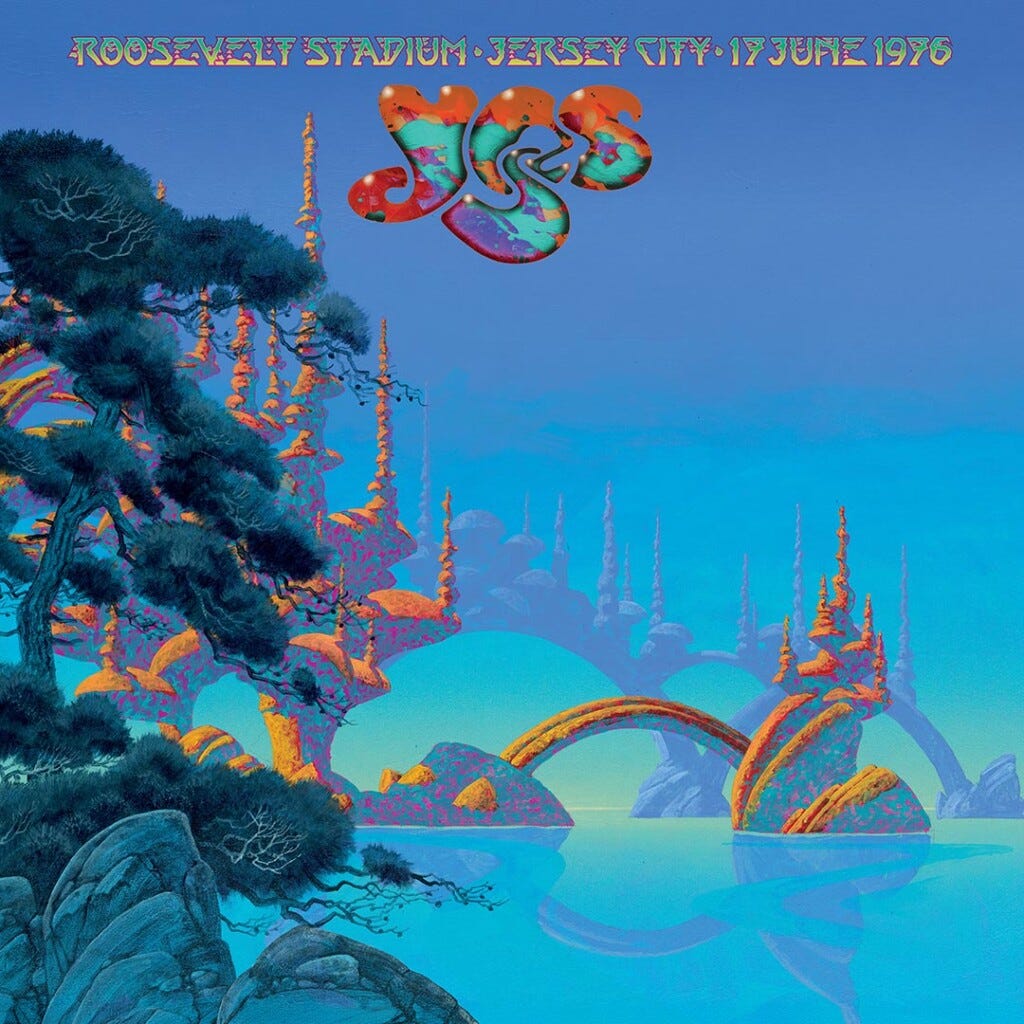
A new upcoming release (set to arrive July 17) breaks that cycle: Yes - Live at Roosevelt Stadium, Jersey City, 17 June 1976, presents a full concert recorded during the band’s touring cycle for Relayer, featuring keyboardist Patrick Moraz in the lineup.
It’s a pretty legendary show that was at the time, broadcast by New York powerhouse WNEW-FM. The essential Forgotten Yesterdays fan site has been taking a look at how the audio that’s been released so far compares to the existing bootleg recordings. In short, it doesn’t appear to be a huge upgrade (yet it’s one I can’t wait to acquire, readers).
They also brought me back to a favorite book that I really enjoyed when it was first released in 2001. As a guy who’s been working in radio for over three decades now, I’ve always loved reading about the classic era of radio and though there are many books/memoirs on the subject now, at the time that Richard Neer released FM: The Rise and Fall of Rock Radio, books like his were harder to find. If you love fly on the wall perspective about radio in the ‘70s and the record industry in that time, Richard’s book is essential.
WNEW is among the legendary stations that Neer worked at during his career and as Forgotten Yesterdays points out, he devoted a good bit of text to sharing the story behind the radio station’s broadcast of the Roosevelt Stadium gig and it’s quite a tale, which I’ll paste in here from FY’s Facebook share.
[Scott] Muni, through his friends at Atlantic Records, had set up a live broadcast of Yes from the now defunct Roosevelt Stadium in Jersey City This was a major coup and the record company took the position that the station should pay for the technical arrangements. They reasoned that a band of Yes’s stature assenting to a live broadcast constituted doing the station favor.
We spoke to Mel about producing the show and he immediatled balked. Since we already worked for WNEW-FM, why should we be paid extra to produce a station event?
The answer was that it required days of preparation time and that this task had nothing to do with our jobs as disc jockeys. We’d have to lease a truck, set up lines to the stage, pay our technical whiz David Vanderheyden to mix the show, et cetera. It was a big undertaking, and we weren’t getting rich by doing it.
Mel didn’t see the need to have a separate mix for radio. Why didn’t we just take a feed off the mixing board? That was possible, we said, but highly unreliable since what may be acceptable audio for a thirty-thousand-seat stadium wouldn’t necessarily work on a stereo broadcast. Plus we’d be at the mercy of the mixing engineer’s skill level.
Mel wasn’t buying it. He decided that we’d just take a feed off the board. What about the production? we asked. Coordinating stage cues for radio? Not necessary, he ruled. You guys will be there as hosts anyway. I’m sure you can handle it on the fly. We offered a third way. We said that for $125, we’d oversee the whole operation so that the show would run crisply. but not take responsibility for the mix, which was out of our control. He said no, and that ended our discussion. We decided to merely act as announcers for the event -- and let the chips fall where they may on the production end.
The night of the concert was a disaster. The station’s chief engineer brought a couple of microphones out for radio introductions and set them up in the huge infield area behind the stage. We had no means to communicate with the stage manager, so we had no idea when the band would be ready to begin. We made several false starts. The lights went down and we came on, described the scene, and told our listeners the concert would start momentarily. After a few minutes killing time with banter about the group. the lights went up again and we threw it back to the station. Muni was angry.
“Why is this so poorly organized? What’s going on with you two?”
“Scott,” I said, “we’re not in charge here. Mel decided not to hire us to produce, so we’re just here to help you host.”
“Why didn’t he hire you to produce?”
I then uttered what could have been fatal words. “Because he’s a cheap bastard who doesn’t care what this sounds like. He’s just trying to save a couple of bucks, and we’re the ones who look bad.”
Pat [Dawson] added, “Yeah, we tried to talk some sense into him but the hard-headed bastard wouldn’t listen.”
Unbeknownst to us, Karmazin was back at the station, supervising the broadcast from that end. While we were talking to Muni, holding the microphones at our side, the overmatched engineer had kept them active. A live feed of everything we said was beaming back directly to the station, where Mel listened on the cue channel
We finally got the show on, and the mix, although not up to our standards, wasn’t bad. During intermission, we got word that Mel had heard our conversation and wanted to see us the next morning, ostensibly to fire us.
Scott said that he’d handle it and indeed he did. He later told us that Karmazin was furious and wanted our heads, but had to admit that we were right and that he should have used us to produce the concert. And from that point onward, any live broadcasts we did were under control and came off flawlessly.
See what I mean? As I said, the Neer book is great and the above passage sent me back down the rabbit hole to start a fresh read. The Roosevelt Stadium show might not be a five star recording, but I do like and appreciate that they’re giving us an official release of that material, cleaned up with today’s technology and presented to us in a proper package. It gives me hope that when they get to the Tormato era, hopefully we’ll get a similar release for the band’s 1978 Ohio performance at the Richfield Coliseum, a long gone venue located a short car ride from the Cleveland area. Broadcast by WMMS-FM at the time, it’s one of their best recorded performances from the decade, in my opinion.
Listen below for yourself and form your own opinion. (But let me help..it’s such a good show!)
Stoked to hear this stuff - and I passionately endorse the Neer book, one of my favorites of the era and trade!